Terrain in Games
Traditional implementation of terrain in games (1995-2002)
Top-down examples
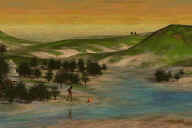
- Black & White

- in their art notes, claims to have novel approaches for ground
textures:
- .. "different terrain types meld together using various criteria and
filters so you should never see the same piece of texture twice on the
landscape"
- "unique texture for every square inch of the ground, allowing it to
reflect all sorts of terrain – without a hard edge in sight...
glistening lakes and tiny, pixel perfect ripples lapping at the
coastline"
- wireframe screenshots indicate that the terrain is a simple
brute-force regular grid
Unconstrained ground examples
-
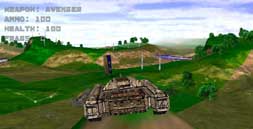
Treadmarks
(1999)
- most impressive terrain in a game as of year 2000
- dynamic LOD and a deformable(!) terrain
- OpenGL-based, variable error threshold and clipping distance
- very fun
- author Seumas McNally cited ROAMing
Terrain as a good starting point
- learned many things in a
conversation with Seumas, July 1999
-
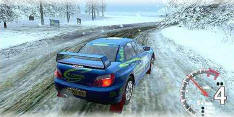
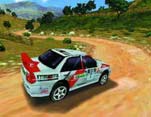
Colin McRae Rally
(1998-present)
-

for
PlayStation and PC, from UK developers
CodeMasters
- very impressive-looking screenshots
- trees look like billboards, but roads and roadsides look great
- good art for sky textures and countryside, but is the user allowed to
leave the road?
- Trespasser (1998)
- before release, this game was intensely hyped for its terrain:
- "Trespasser is largely an outdoor game, the most beautiful
and detailed ever attempted in 3D. You will have kilometers of
forest, plain, and dark jungle to cross, beautiful vistas and hidden
canyons."
- however, the released game was very disappointing
- They used a continuous LOD approach, and their allowed error bound
is enormous - resulting in visual "pops" of as much as 50 pixels or
more. The ground grid spacing is very wide, making it appear
extremely planar.
- Looked terrible on the 8MB cards common at the time, and on 16 MB
/ AGP systems, there were still problem with ground texture tiling
too obvious, and significant elevation pops.
- all "levels" were hand-modeled in 3DS MAX
- approximately 30 developers were on the team. graphics people
included: Mark Langerak: development lead in charge of terrain, and
Scott Peter: rendering (including lighting and water modeling/rendering)
Unconstrained air examples
- Bombs-Away B17-II
- Flight combat simulation
- "Countryside" has no discernible elevation variation, but very good
textures
- One of the developers,
Dominic Robinson of Wayward Design, tells us:
- "65x65 cells, paged quadtrees, wavelets..."
- "All the textures are resolution independent, procedurally
generated with both color and bump channels. They currently resolve down
to a feature size of 20cms ( but can go lower ). The terrain is rendered
with a full sky light model, self shadowing, plus shadows from buildings
and clouds. Texture areas are trimmed and composited with sub-pixel,
anti-aliased cubic beziers.
- The terrain mesh is generated on the fly from a procedurally
amplified DEM height map - the current raw DEM dataset is ~600Mb ( 100m
spacing 16 bit height samples ) for a sizeable chunk of NW Europe. The
mesh is frame coherent and morphs to introduce/remove detail. No
'variance' or other pre-processing is required other than structuring
for disk access.
- View point and direction can be completely arbitrary, with no
draw distance limit - you can zoom from an altitude in excess of 600
million feet, at which the full dataset is visible at about the size of
a postage stamp, to zero feet, continuously."
- Falcon 4

,
late 1990s
- used a patchwork of re-used aerial photos for high resolution
large-area coverage
- excellent water and water boundary textures
- supported time-of-day with sunset and stars
- designer's notes gave insight into the terrain engine used, but
they're not online anymore
- personnel: Scott Randolph, Senior Graphics Engineer, Falcon 4.0 Team,
Spectrum HoloByte/Microprose
-
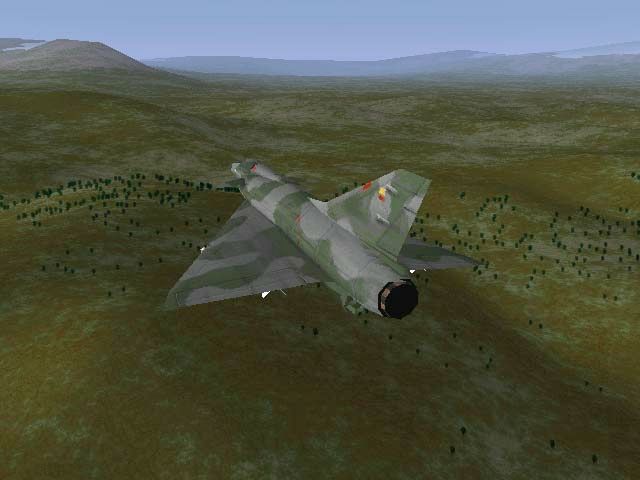
Joint Strike Fighter
- developed by Innerloop,
distributed by Eidos Interactive

- from an interview with Henning Rokling of Innerloop Studios:
- "The terrain engine - IFS, Iterated Function Systems - is a clever
way of storing extremely huge terrains in very little space. It reduces
the number of polygons of the terrain in the distance, while keeping the
texture and elevation detail at the same high quality. We've created an
in-house tool allowing us to take real-world elevation data and texture
maps, and generate the math data for displaying all of this realtime.
When rendered, it uses normal polygons for the mesh.
Each terrain map has 1.125 billion billion polygons.
Each campaign is made up of 2.4 million square miles of real world
terrain. The elevation in each campaign has been taken from satellite
images, with elevation correct down to a grid of 100x100 meters. In
between the elevation grid, we fill in the most plausible elevation
pattern through complex algorithms to make it seem real, and according
to a lot of enthusiastic beta testers, it looks very realistic."
- does not support Direct3D or OpenGL! uses a software
renderer or Glide.
- very high-resolution and beautiful soft lighting on the terrain, but
ground is much too smooth to be realistic
- trees are very, very small billboards - probably accurate size, but
much too sparse
- cities consist of nicely-modeled rectangular buildings, but
just
buildings
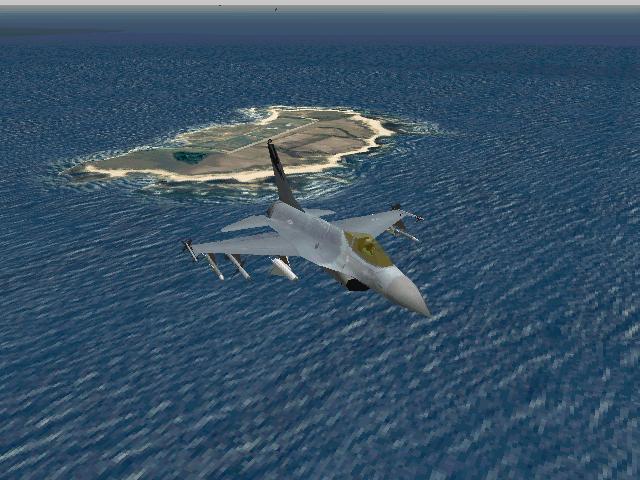
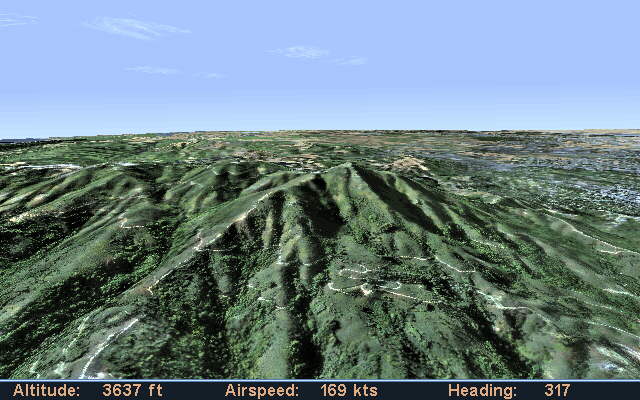
- Flight Unlimited II from Looking Glass Studios

- probably the most realistic aerial terrain in any PC game title as of
2003
- uses the SF bay area as data
- it's likely they used the BARD
data and colorized it: by hand, or by algorithm, or by using color
information from lower-resolution satellite images
- from an interview with Constantine Hantzopoulos of Looking Glass
Technologies:
- An immense amount of both research and work has gone into
creating ZOAR, their terrain and object rendering engine, created by
their lead programmer Jaemz Fleming. Their 4 main goals were:
- rendering 4 meter per pixel color satellite imagery
- getting a ton of it somehow
- rendering out to the horizon - no clipping of terrain and
objects
- no popping of terrain.
- ZOAR removes polygons, not textures, intelligently on the fly,
only renders height when needed,
- The effect is truly rolling terrain as you get lower and lower
without loss of frame rate.
- SAIC provided them with the ortho-corrected data as they felt
that having DOQ imagery to government QA specs would be better than
handling it themselves
- Super sneaky methods were used to color correct and render it
all.
- They could render 1 meter per pixel imagery if they so choose.
They didn't because they don't have the storage capacity for that.
That's why they went with 4 meter data. DVD though...
- they were working on a Flight Unlimited III (but it never got
distribution)