Plants - Books and Academic Papers
Recent Developments
-
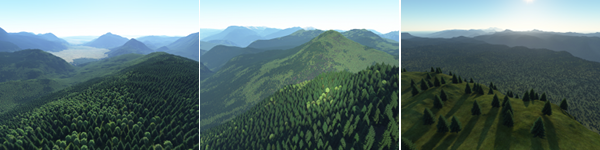
Real-time Realistic Rendering
and Lighting of Forests, 2012
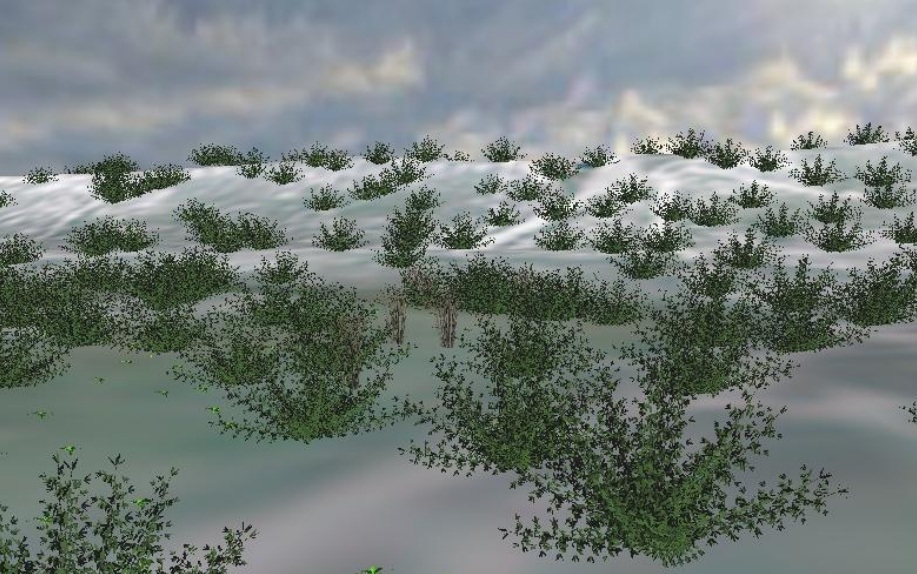
- Eric Bruneton and Fabrice Neyret, Proceedings of Eurographics 2012
- Good-looking realtime implementation of "sun and sky dome
contributions, shadows between trees, inside trees, on the ground, and
view-light masking correlations", without popping or aliasing.
- Based on two new forest representations, z-fields and shader-maps,
with a seamless transition between them.
-
-
Implemented in the open-source terrain library
Proland.
-
Texture-Lobes for Tree-Modelling, 2011
- Livny, Pirk, Cheng, Yan, Deussen, Cohen-Or, Chen
(China/Germany/Israel), ACM Trans. Graph. 2011
- Abstracts the tree's foliage into canonical "lobe-texture" geometry,
which can be stored and rendered very cheaply.
- Can be used to reconstruct laser scanned trees (from point
clouds) or re-representing existing tree models (e.g. polygonal, from
Xfrog)
-
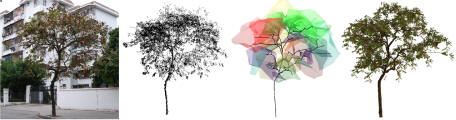
- It looks great, and the storage savings claimed are very attractive
(e.g. 56MB Xfrog model vs. 65KB lobe model). However, a complicated approach like this is more implementation than theory,
so a public implementation would be needed to make it actually useful;
the website says "application: available soon", so we can hope.
-
Exploring 3D visualisation of vegetation, 2010
- Joël Hempenius, Univ. Utrecht, thesis.
- Gives an overview of the many issues and approaches for modeling and
distributing plants on terrain: L-systems, AMAP, XFrog, GIS
distribution, cellular automata, interpolation, etc.
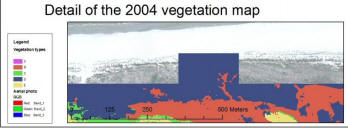
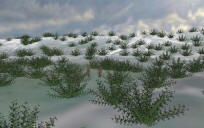
- A case study dataset was processed for the Ameland area in the
Netherlands, using PlantGL and XFrog to make plant models and the VTP
software (VTBuilder/Enviro) to visualize the results, with much
evaluation and conclusions.
-
-
Image-Error-Based
Level of Detail for Landscape Visualization, 2010
- Malte Clasen, Steffen Prohaska, VMV
- LOD approach for fast realtime plant rendering, using a hierarchy of
unconnected primitives (ellipsoids, lines)
- Implemented in their Biosphere
3D software

-
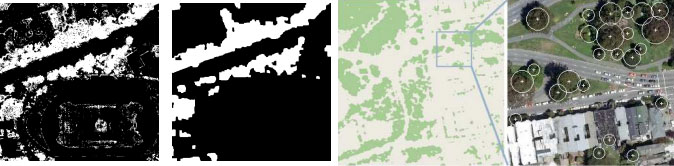
Tree detection from aerial imagery, 2009
- Lin Yang (U. Alabama) & 3 others from Google, ACM GIS ’09
- A pixel-level classifier is trained to assign a {tree, non-tree}
label to each pixel in an aerial image, then refined by a partitioning
algorithm to a clean image segmentation of tree and non-tree regions.
Then, they use greedy selection to locate individual tree crowns.
- This work was done at Google, so it probably relates to Google
Earth's "3D tree" coverage, which was publicly released a year later
(2010)
-
-
 NDVI-based
Vegetation Rendering (PDF
PPT)
NDVI-based
Vegetation Rendering (PDF
PPT)
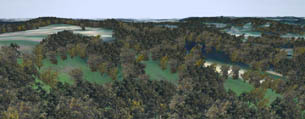
- Stefan Roettger, In Proc. CGIM '07, IASTED Press, February
2007
- Describes using NDVI (Normalized Difference Vegetation Index) as a
guide to distributing representative vegetation, derived from LandSat
Channels 3 (red) and 4 (near infrared). NDVI values are mapped to plant
height, from low values for grass to higher values indicating tree size.
- Example dataset has 10 million trees, reduced to 100k trees with
culling, rendered at 30 fps.
-
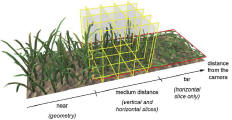
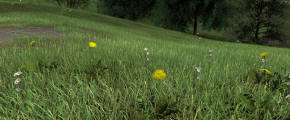
Rendering Grass Terrains in Real-Time with Dynamic Lighting
- sketch and paper by Boulanger, Pattanaik, and Bouatouch, Siggraph
2006
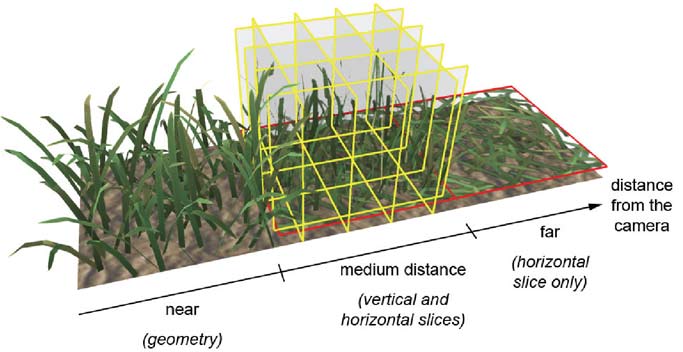
- uses per-pixel lighting, grass density maps, and three levels of
detail: geometry, vertical, and horizontal slices, with smooth
transitions between them
- claims worst-case 20 fps, common-case 80 fps or better on a NVidia
7800 GTX
- when highly anti-aliased, the results are beautiful
-
- Rendering
Forest Scenes in Real-Time
-
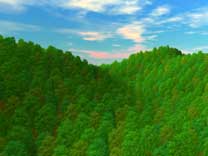 Philippe Decaudin and Fabrice Neyret, Eurographics Symposium on
Rendering, 2004
Philippe Decaudin and Fabrice Neyret, Eurographics Symposium on
Rendering, 2004
- uses texture-slicing to produce dense forests corresponding to
continuous non-repetitive fields made of thousands of trees with full
parallax
- the forest consists of a set of edge-compatible prisms containing
forest samples which are aperiodically mapped onto the ground, with
special treatment of silhouettes on ridges
- relies on LODs and on a GPU-friendly structure to achieve real-time
performance
- there are more details on Decaudin's site
Antisphere: Rendering Forest Scenes in Real-Time
- follow-on work:
GPU-Based
Lighting and Shadowing of Complex Natural Scenes
-
 Interactive
Visualization of Complex Plant Ecosystems
Interactive
Visualization of Complex Plant Ecosystems
-
O.
Deussen, C. Colditz, M. Stamminger, G. Drettakis, IEEE Visualization
2002, October 2002
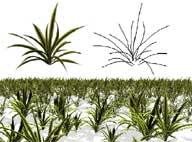
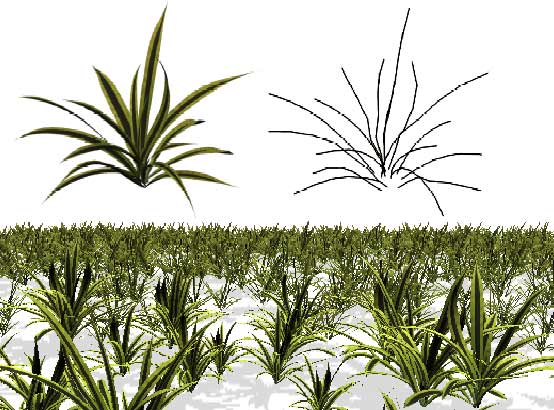
- describes an approach for drawing plant LODs using primitives
(points, lines)
- points are used mostly for leaves on trees, and flower petals
- lines are used for the blades of grasses
- octrees are used to efficiently choose which LOD to use, and
display lists are used for fast rendering
- they can do massive scenes (>120 million triangles full detail) at
several fps on a GeForce 3
-
Generating spatial distributions for multilevel models of plant communities
(pdf)
- Brendan Lane and Dr. P, 2002 proceedings of Graphics Interface
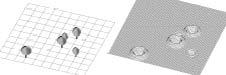
- describes two methods of distributing plants
- using an L-system-like approach (!) for simulating plant
competition
- using a probability field which is deformed by each plant
iteratively
-
Modelling
of ecosystems as a data source for real-time terrain rendering (pdf)
- (Abstract)
(Screenshots)
- Johan Hammes, Proceedings of DEM2001 (Digital Earth Moving, First
International Symposium)
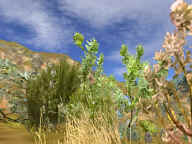
- presents a way in which well-known techniques for modeling
ecosystems can be applied to generate the placement of plants on a
terrain automatically at run-time
- sufficiently fast to allow real-time computation, but also varied
enough to allow for natural looking placement of plants and ecosystems
while remaining deterministic
- active in plant research 1996-2004
- A Stable Modeling of Large Plant Ecosystems, 2003
- shows the importance of using environmental feedback (such as
depletion of the soil) in addition to normal competition between plants
- A Real-Time Visual Models of Plants Interacting with Virtual
Environment, and
- Virtual Climbing Plants Competing for Space, 2002
- give a brief summary of work in progress which actually simulates
both light and collision detection affecting plant growth
Research Projects
-
LIAMA GreenLab
- A French/Chinese academic cooperation, working on a stochastic,
functional and interactive models for plant growth and architecture.
- INRIA is involved, so it may build on previous INRIA work
(below). Philippe de Reffye, one of the AMAP developers, is a
guest researcher at LIAMA and contributed to the development of GreenLab.
- GreenLab functional structural plant model +
Scilab open source software
for scientific computation →
GreenScilab
- The libraries of GreenLab will also contain more Asian species
which are still rare in 3D.
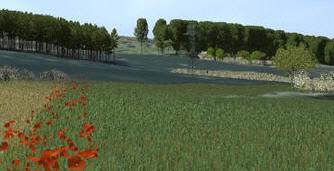
- Lenné3D
- Was a years-long interdisciplinary project focusing on visualization
of vegetation and GIS data, with a significant component having to do
with plants (see the Lenné3D entry on
Government / Academic
Research Projects for more info). In 2005, it spun off as a
commercial services provider, Lenné3D
GmbH
- Virtual Crops -
Architecture and Process Oriented Modeling
and Visualization of Crop Stands
- a German project (2000-2005?) of several universities to support
research into 3D modeling, simulation and visualization of crop plants
- Algorithmic Botany
- site of the Biological Modeling and Visualization (BMV) research
group at the University of Calgary.
- Home of Dr. P (Przemyslaw
Prusinkiewicz)
-
Virtual Plants at INRIA
-
A multi-year
academic project (in Montpellier, France) to analyze plant growth and structure, from a very low
level, such as meristem functioning and development.
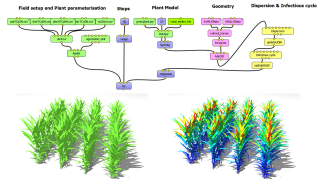
- OpenAlea,
an open-source platform provides a user-friendly environment for
researchers to build plant models using a visual programming interface
and provides a set of tools and models dedicated to plant modeling.
V-Plants is a set of packages in OpenAlea.
-
PlantGL, an open-source C++ graphic toolkit for the creation,
simulation and analysis of 3D virtual plants embedded in the Python
language.
- There doesn't appear to be any realistic models of full plants, as
the focus is more on abstract structure and biological growth at the
microscopic level.
Books
- Trends in
Real-Time Landscape Visualization and Participation, Proceedings at
Anhalt University of Applied Sciences 2005
- includes several Plant papers
-
Computer generated plants (German/English)
- a website for the book Digital design of Nature and related
materials and software, including its German counterpart previously
published:
- Computergenerierte Pflanzen. Techniken und Design
digitaler Pflanzenwelten
("Computer-generated plants. Techniques and Design of Digital
Plant Worlds"), 2002 [at
amazon.com]
- by
Oliver Deussen, an overview of all CG plant and ecosystem efforts
over the years
- The Algorithmic Beauty of Plants, 1990
[at bn.com] [online
as a PDF]
- Dr. Prusinkiewicz and Lindenmayer
- a very complete introduction to L-systems and their applicability to
plant modelling.
- Advances in Computational Life Sciences, Volume 1, 1997
[at
amazon.com]
- Plants to Ecosystem: Modelling of Biological Structures and
Processes
Other Articles
Papers of Dr. P
Other Important Papers
-
Papers and Publications Related to Xfrog
- Plant Models Faithful to Botanical Structure and Development
- P. de Reffye, C. Edelin, J. Francon, M. Jaeger and C. Puech,
Siggraph '88
-
Creation and Rendering of Realistic Trees
- Jason Weber & Joseph Penn, Siggraph '95 [images]
- Interactive Modelling of Branching Structures
- Realistic Modeling and Rendering of Plant Ecosystems [abstract]
[pdf]
-
Deussen O., Hanrahan P., Lintermann B., Mech R., Pharr M.,
Prusinkiewicz P., Siggraph '98
- A Modelling Method And User Interface For Creating Plants [pdf]
- overview of the motivation and implementation of the XFrog package,
1998
 Interactive
Visualization of Complex Plant Ecosystems
Interactive
Visualization of Complex Plant Ecosystems